Enterprise platform · Running at 48 client sites · Open hardware
One platform. Every building system.
iBolt is our enterprise building management platform. Its energy, water, gas and BTU metering modules are in daily production use at 48 client sites; the same platform monitors and controls HVAC, power, water, fire and lifts over the protocols your equipment already speaks — and is built for the 15–20 years after handover: open, off-the-shelf hardware, engineers who stay through year one, and support inside your team's chat.
Modbus RTU / TCPBACnet IP / MS/TPM-BusSNMPMQTTREST & live-data APIs
https://ibolt.yoursite.local/chiller
Screens on this page are from the iBolt solution-framework demo running on simulated process data.
100% browser — no client install
Runs on your server or private cloud
WhatsApp & Telegram alarms, native
Device types & mimics built on site
Every command confirmed & audited
Why iBolt is different
Built for the 15–20 years after handover
Our market survey across 45+ BMS & EMS installations found the same pattern everywhere: brand-name systems are delivered working, then become unsupportable. iBolt is designed around the operational lifecycle instead — at design, at handover and through the long years of operation.
Design & buildOpen
Right-sized, open, affordable
Non-proprietary, off-the-shelf hardware — spec-based, bought on the open market for the system's life
Best-fit solutions: operable by intent, not impressive at proposal stage
Compatible and retrofittable with existing mixed-vendor installations
Low one-time capital cost — no brand premium
Handover & year 1People
Deployment engineers stay on site
The engineers who commissioned the system run it through the first year — included in the project cost
Site-specific training as a contractual deliverable, not a courtesy
After year one, retain or recruit those engineers into your own O&M team
Knowledge stays in the building — permanently
Long-term operationsMinutes
Support in your team's chat
iBolt technical support sits inside the maintenance team's existing messaging groups
Message, not ticket — diagnosis starts in minutes; most issues never need a site visit
Minimal AMC, structured to fit building operating budgets
Multi-supplier spares — a failed device is replaced with a competitively priced off-the-shelf part
iBolt talks to the equipment you already own — through its own gateway software near the field — and organises it as a tree: Client → Site → Building → Floor → Area → Device → Parameter. Every reading, alarm and report knows exactly where it belongs.
Temperature, humidity, occupancy, wireless via MQTT
Fire alarm, lifts, access control
Monitoring & annunciation — never a replacement
Controllable devices
Valves, breakers, setpoints — confirmed and logged
Capabilities
A complete BMS, module by module
Sixteen functional modules across five groups — foundation, operate, respond, analyse and platform. The same tree, alarms, notifications, reports and users serve every equipment type.
Device & asset modelling
User-defined device types with parent–child devices (an AHU with its sensors), engineering units, scaling, limits, formula and derived parameters, enumerations and site-friendly names. Templates import and export across sites.
Foundation →
Real-time monitoring & control
Live values within seconds, tabular and graphical views, live trends, and write operations with permission checks, confirmation, read-back verification, override / release and a full command audit trail.
Operate →
Mimics & dashboards
A browser-based drag-and-drop mimic editor with HVAC, electrical and water symbols, floor-plan backgrounds, animation and click-to-command — plus role-specific dashboards, KPIs, multi-site overview and kiosk mode.
Operate →
Alarms & events
Threshold, deviation, rate-of-change, digital-state and communication-failure alarms with deadband and time delay so nuisance alerts stay out. Severities, acknowledge, shelve, escalate, live console and event log.
Respond →
Alert distribution
Email, SMS, WhatsApp, Telegram and mobile push as native channels. Route by role, site, device group, severity and shift; escalate if nobody acknowledges; every delivery logged.
Respond →
Scheduling, sequences & automation
Weekly schedules and holiday calendars, if / then interlocks, duty–standby rotation, and ordered start-up / shutdown sequences with delays and wait-for-feedback — written in forms or as plain-English scripts.
Respond →
Historian, reports & analytics
Keeps every reading and event; builds 15-minute, hourly, daily, monthly and shift-wise totals automatically. Trend comparison, a report builder, scheduled delivery and Excel / PDF / CSV export.
Analyse →
Energy management & billing
Meter hierarchy with roll-up and loss detection, targets vs actual, utility-bill reconciliation, peak-demand tracking, kWh/m² and kW/TR KPIs — and tenant / common-area billing with mains + DG rates and prepaid balances.
Analyse →
Maintenance & asset health
Runtime hours, trips and service-due alerts per equipment; filter and consumable status feeding maintenance tasks; work-order style follow-up and hooks into your CMMS.
Analyse →
Users, roles & audit
Granular RBAC scoped to client, site, subtree, device group or parameter, with a separate permission for control. Built-in authentication with password policy and optional TOTP; AD / LDAP / SSO as an adapter. Everything logged.
Platform →
Mobile app & open APIs
iOS and Android apps for live values, alarms with acknowledge, push notifications and permitted control. REST read / write, WebSocket / MQTT live feed and webhooks for ERP, tenant apps and dashboards.
Platform →
AI assistant — on your premises
Ask in plain language — "which floor used most yesterday?", "why did that alarm fire?" — answered from your own data and documents by a model that runs on site. Actions only with permission and confirmation; never autonomous control.
Platform →
Metering & billing — in production at 48 sites
Every unit accounted for. Every tenant billed fairly.
Energy, water, gas and BTU meters in one tree with automatic 15-minute, hourly, daily, monthly and shift totals. Compare floor vs floor, tenant vs common area; reconcile utility bills against your incomer; bill with mains + DG rates, demand charges and prepaid balances.
Ready-made device libraryTemplates per meter model — add a new meter in minutes; the library grows with every project.
Calendars, shifts & tariff periodsWorking days, holidays, shifts and peak / off-peak hours, shared by alarms, reports and billing alike.
Meter faults & comm loss caughtStale readings, rate-of-change anomalies and lost links raise alarms — before the month-end surprise.
Bill import & reconciliationImport the utility's bill and compare it with what your incomer actually recorded — kWh or kVAh.
Plant operation
Control you can trust — because nothing acts silently.
Start a chiller, reset a tripped fan, change a setpoint or trip a breaker from the mimic. Every command is permission-checked, confirmed by the operator, verified against the device's read-back and written to the audit trail.
Spec-exact equipment pagesChillers, AHUs, STP / WTP, DG, transformers, electrical rooms, ventilation, lifts, UPS and fire — each with mimic, parameters, trends and alarms.
Interlocks with approvalAn alarm can trigger an action — close a valve, shed a load — under rules your engineers set, with arming and dry-run.
Cross-coupled by designA mains failure flows into the DG page, the emergency panel and the AHUs — because it is one model, not many screens.
Works without internetMonitoring and control run on your network; gateways keep collecting even if iBolt Core is unreachable.
automation script · ahu-staggered-restartvalidated · dry-run ok
-- Restart AHUs one by one after power returns, to limit inrushWHENMains.StatusIS ON FOR60 sIFDAY IS WORKING DAYANDTIME BETWEEN07:00AND20:00FOR EACH ahu IN GROUP"Tower A — AHUs"START ahu
WAIT UNTIL ahu.RunStatus IS ON WITHIN30 sELSERAISE ALARM"AHU failed to start"ANDCONTINUEWAIT45 sENDNOTIFYFacility-ManagerVIA WhatsApp "Tower A AHUs restored"ENDEND
Sequences & plain-English automation
Logic your engineers can read — and write.
Fill in a form, or write short scripts in controlled English with a fixed keyword set: WHEN … FOR, IF / ELSE, FOR EACH … IN GROUP, WAIT UNTIL … WITHIN … ELSE, SET, START / STOP, NOTIFY, RAISE ALARM. No programming.
Staged start-up & shutdownPumps → cooling tower → chiller with flow proof; load-shed by priority and staged restore; DG ↔ mains change-over.
Editor with guard-railsKeyword completion, live validation, simulator and dry-run; scripts are versioned, sandboxed and bounded.
Same engine, same safetyScripts run through the standard command path — verification, arming, approval and audit — exactly like form-based rules.
Product tour
See iBolt in action
Module pages from the iBolt solution-framework demo — a two-tower commercial campus with 17 modules on simulated data.
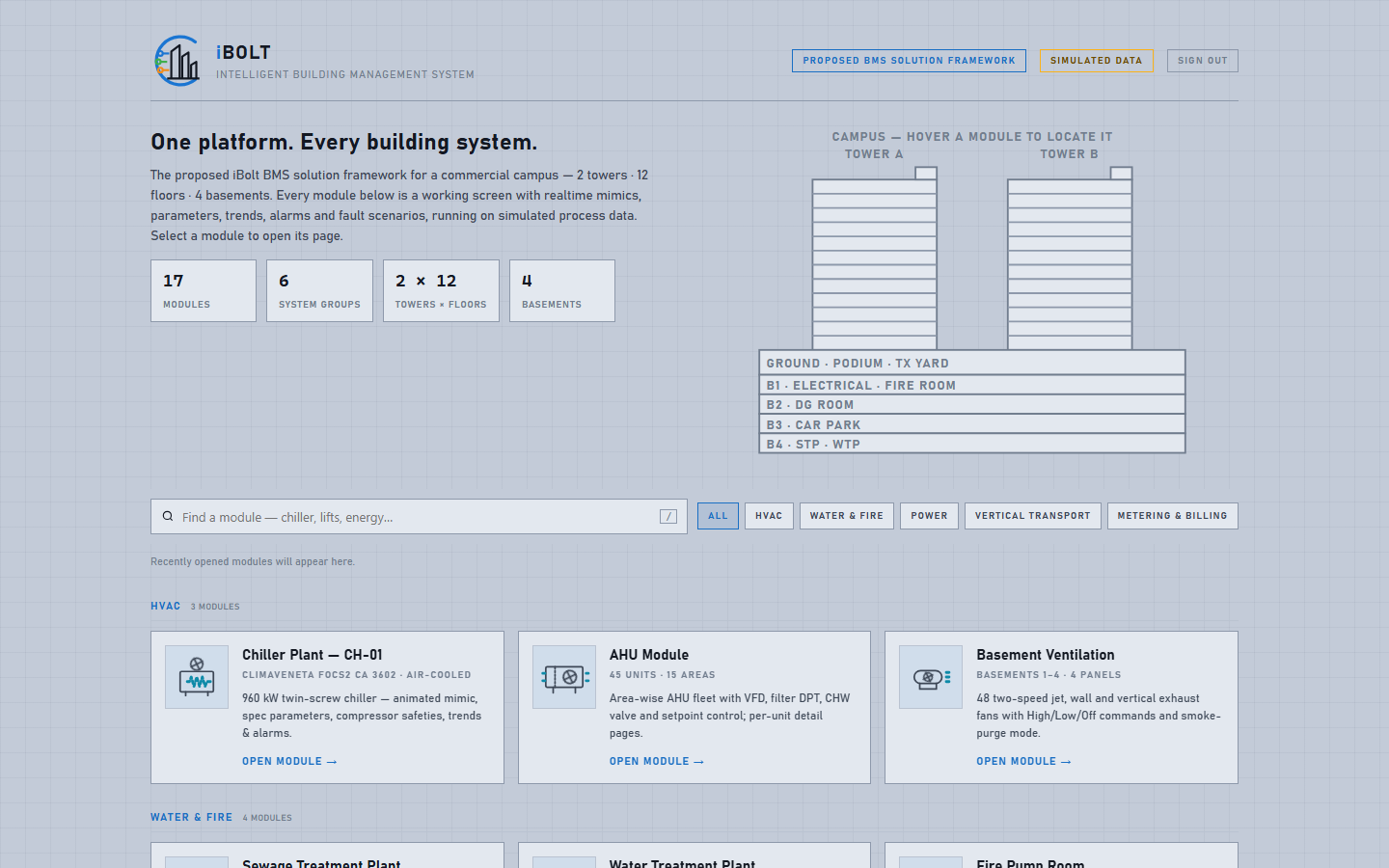
https://ibolt.yoursite.local/
Home — every module of the campus, searchable, with a locator that lights up where each system lives.
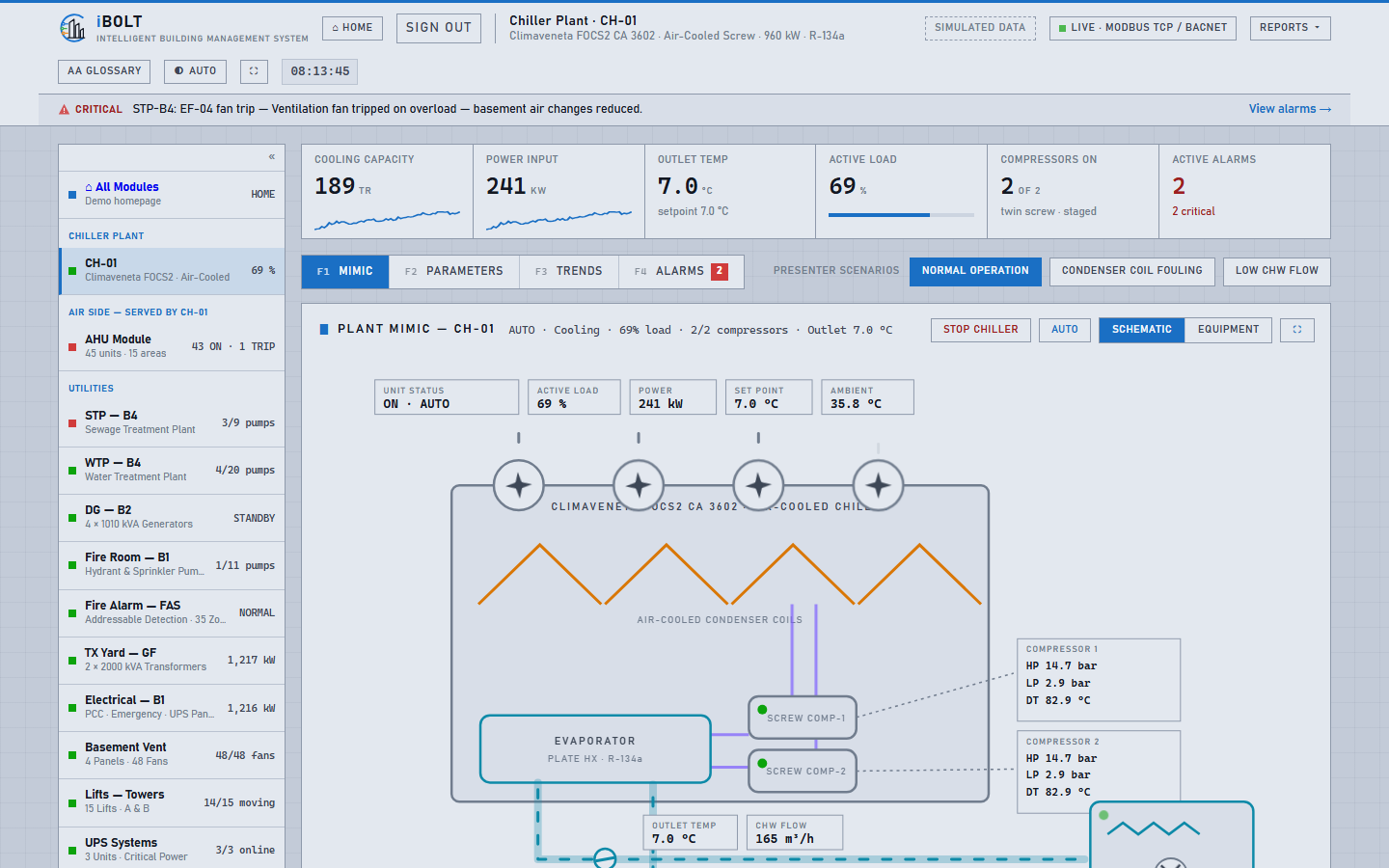
https://ibolt.yoursite.local/chiller
Chiller plant — live mimic, compressor safeties, KPIs, trends and alarms with confirmed start / stop.
https://ibolt.yoursite.local/ahu
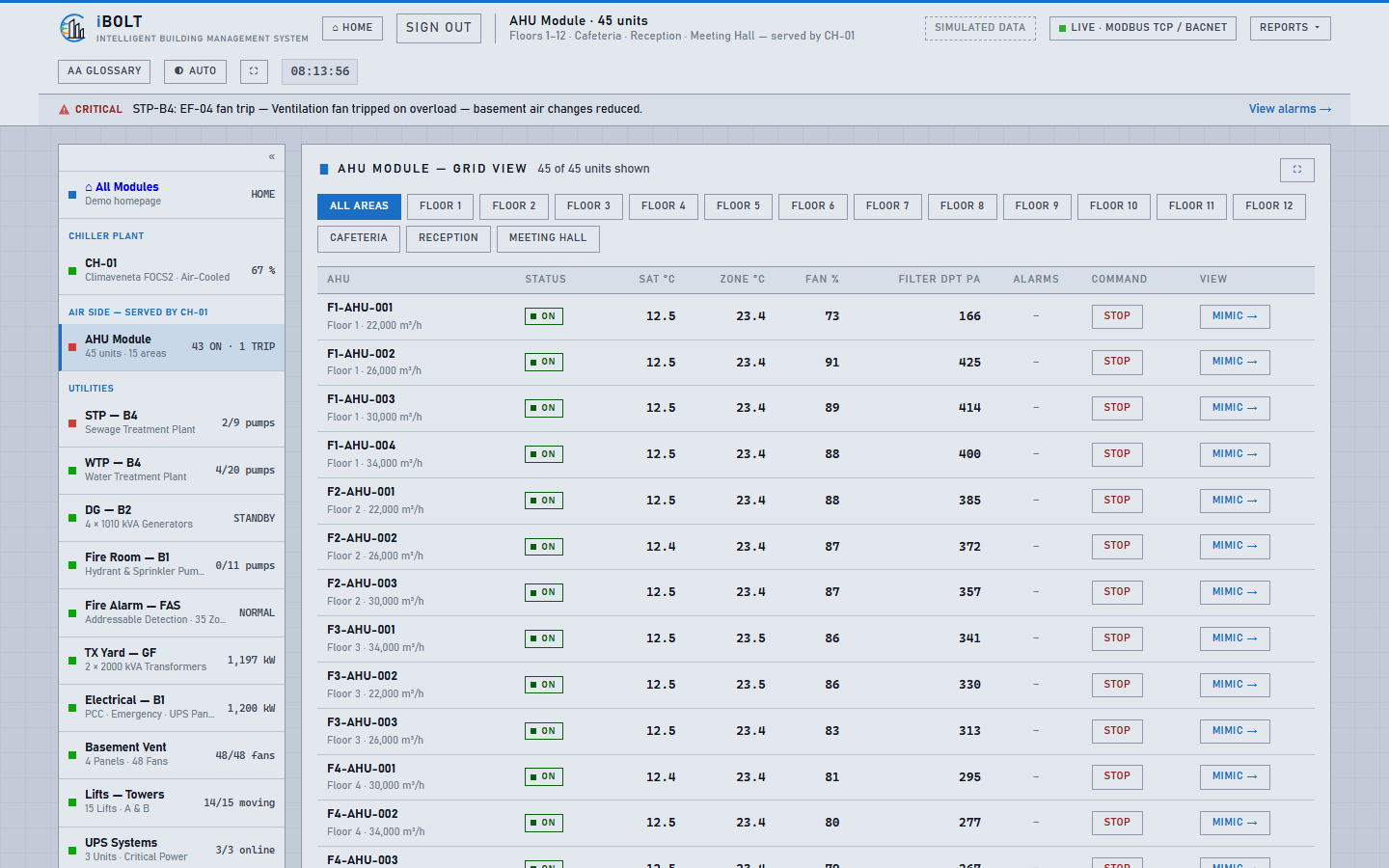
AHU module — 45 units across 15 areas with VFD, filter DPT, CHW valve and setpoint control.
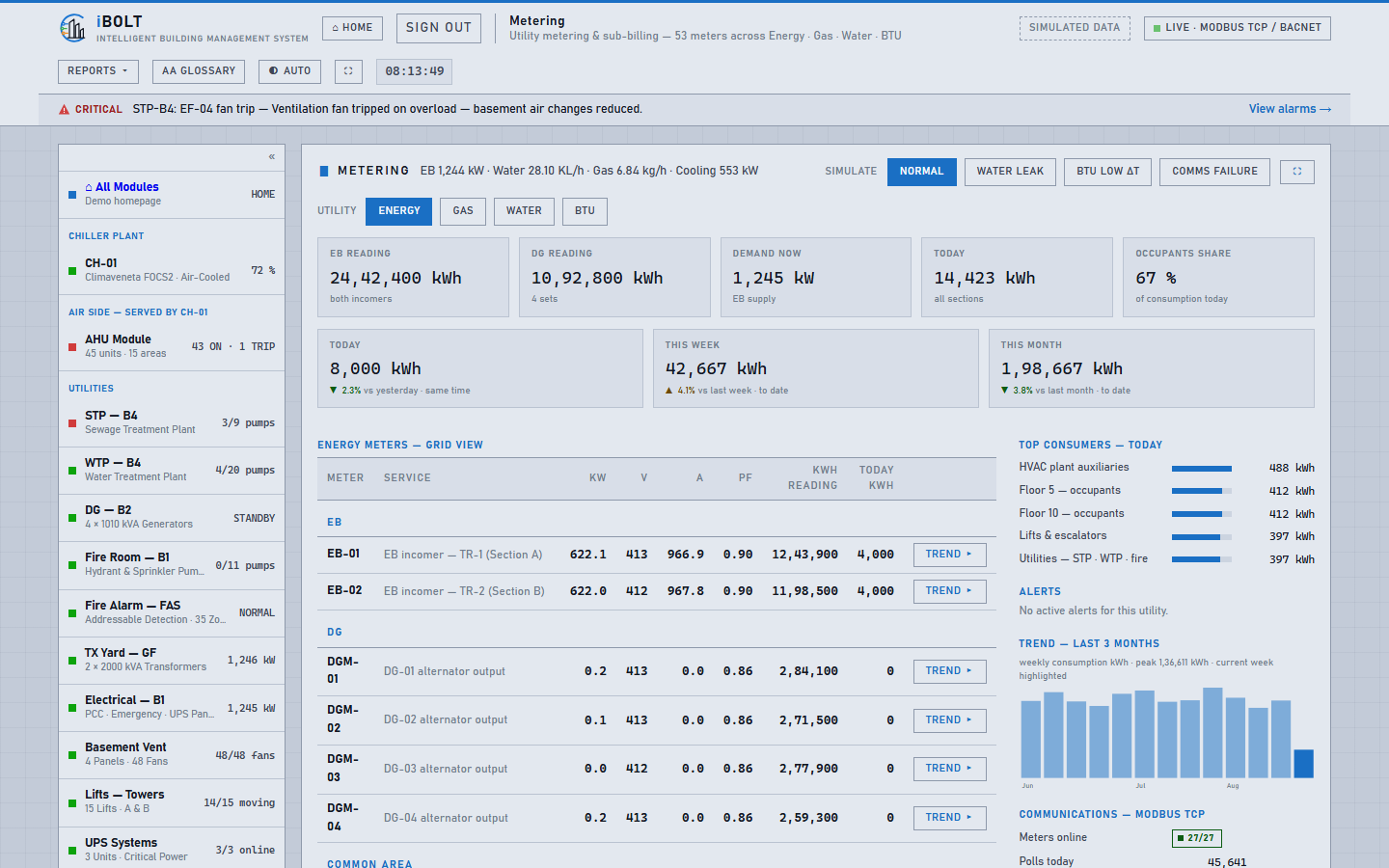
https://ibolt.yoursite.local/metering
Metering — energy, gas, water and BTU with period comparisons, top consumers and comms health.
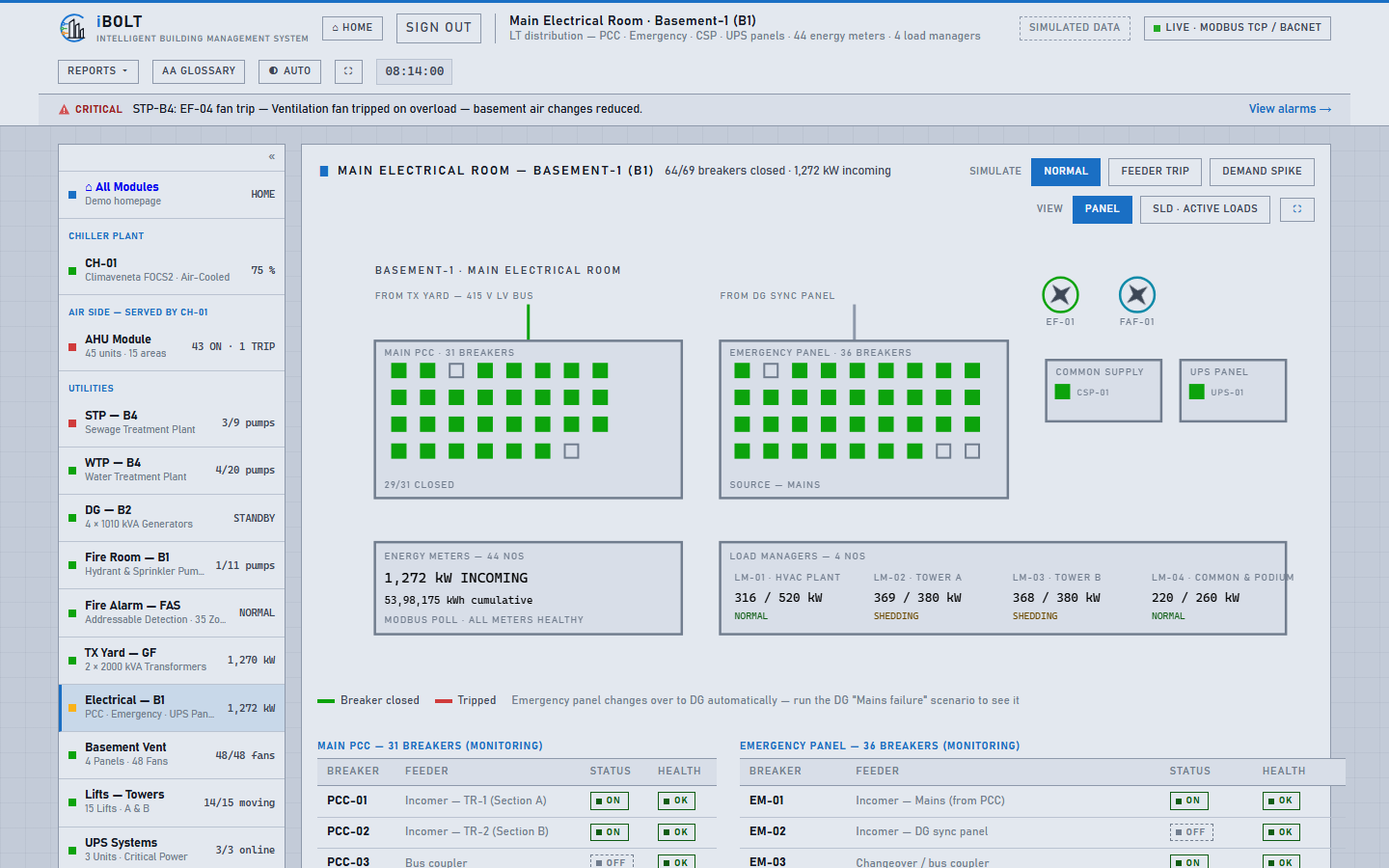
https://ibolt.yoursite.local/electrical
Main electrical room — PCC and emergency panels, 44 energy meters, load managers and a live single-line diagram.
https://ibolt.yoursite.local/dg
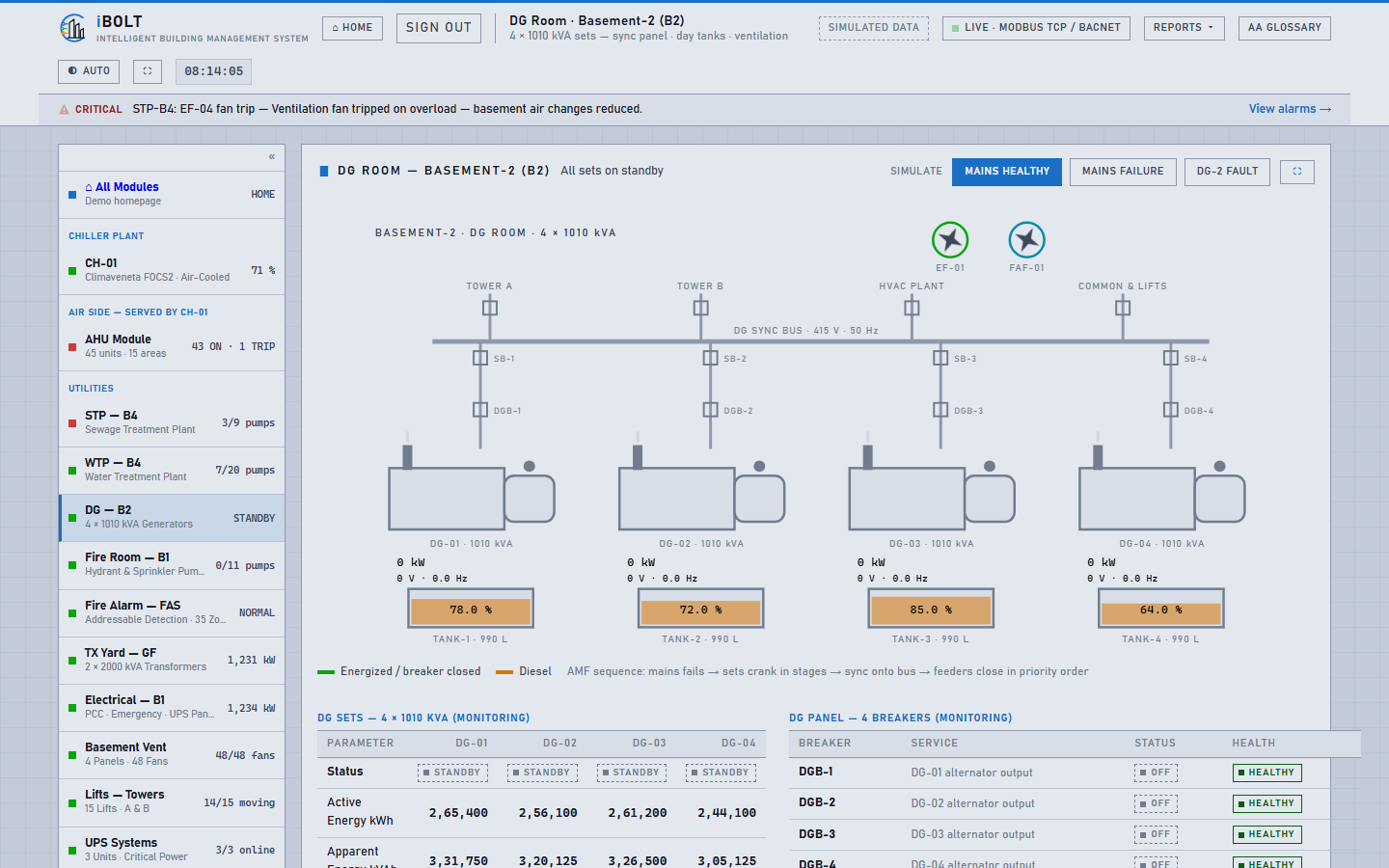
DG room — four sets with AMF auto-start, sync and load-share, day tanks, breakers and run hours.
5
Field protocols + MQTT for IoT
≤ 2 s
Field change to screen (target)
5
Alert channels with escalation
48
Client sites in production
Brand-name BMS vs iBolt
Same integration breadth. A different lifecycle.
iBolt matches the protocol coverage of legacy building-management suites and differs where it matters to the people who run the building: hardware, handover, support and cost over 15–20 years.
Other systems — ERP, prepaid / tenant apps, dashboards via API
What iBolt deliberately does not doHonest scope
It monitors and annunciates fire alarm and life-safety systems — it does not replace them.
Control actions are only ever pre-approved, confirmed and audited; nothing acts silently.
No cloud AI: the assistant, when enabled, runs entirely on your premises.
Control-loop logic stays inside your PLCs / DDCs — iBolt supervises, it does not re-program them.
FAQ
Questions we hear from facility teams
No. iBolt supervises — it reads from and writes to your controllers over Modbus, BACnet, M-Bus, SNMP or MQTT. Control-loop logic stays where it is; iBolt adds monitoring, alarms, sequences, reporting and billing on top.
Most vendors expose a Modbus, BACnet or SNMP interface, and iBolt's driver framework is built to add protocols (OPC UA, KNX, DALI, DLMS) as demand arises. Where a vendor offers none, a third-party gateway bridges it — we will tell you which during discovery.
Not for monitoring and control — iBolt Core runs on a server at your site. Internet is only needed for outbound channels you choose to use, such as WhatsApp, SMS, email or a multi-site private-cloud deployment.
Your engineers can — the mimic editor, device templates and alarm rules live in the browser with no extra licence. We commission the first site with you and hand over; after that you are not dependent on us for changes.
The engineers who deployed iBolt stay on site through the first year of operation, included in the project cost. Site-specific training is a contractual deliverable. After year one you can retain or recruit those engineers into your own O&M team, so the knowledge of how your building actually runs never leaves the building.
iBolt technical support sits inside your maintenance team's existing instant-messaging groups. A fault is raised as a message, diagnosis starts in minutes, and most issues never need a site visit. When a device does fail, it is replaced with a competitively priced off-the-shelf part from any supplier — not an OEM-only price list.
Modular, point-count based, and available as one-time on-premises licensing or a subscription. Energy management and the open API are included, not add-ons; the AMC is kept minimal and structured around the building's operating budget rather than an OEM profit structure. Ask us for a quote with your point list.
See iBolt on your building's equipment
Bring your meter list, your plant schedule or just your questions. We'll walk you through the platform and map it to your site.